
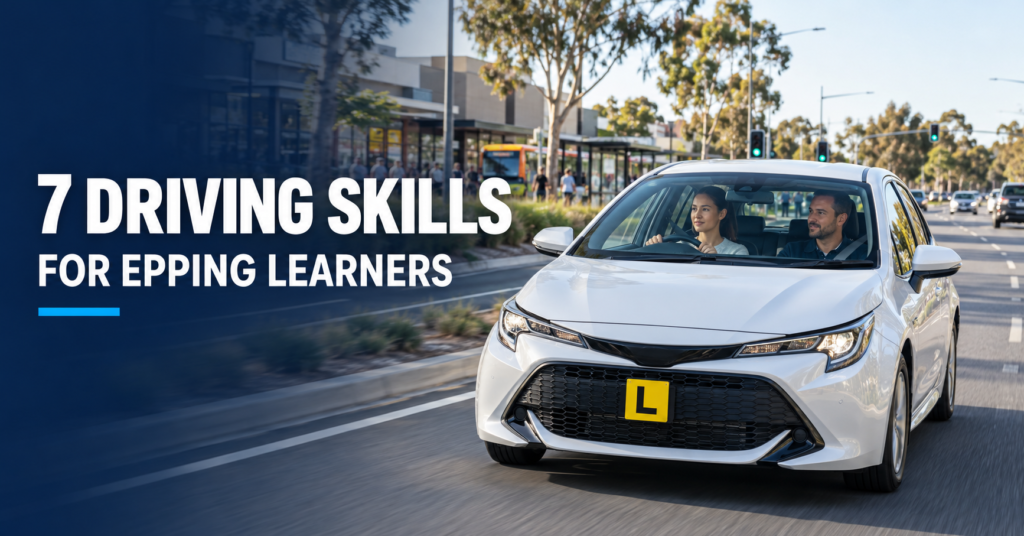
7 Everyday Driving Skills Learners Should Practise in Epping
Learning to drive involves much more than controlling the steering wheel and remembering the road rules. A safe driver must observe the surrounding environment, identify potential hazards and make calm decisions as traffic conditions change.
Epping provides learners with exposure to residential streets, shopping areas, railway activity and busier connecting roads. This variety can help learners gradually progress from basic vehicle control to more complex everyday driving situations.
If you would like structured instruction tailored to your experience, explore our driving lessons in Epping. Lessons can support complete beginners, nervous learners, returning drivers and people preparing for their driving test.
Here are seven practical skills that learner drivers should develop before driving independently.
1. Looking Beyond the Vehicle in Front
New learners often concentrate on the space immediately in front of the car. While this feels natural, it can reduce the time available to respond to traffic signals, pedestrians, slowing vehicles or approaching intersections.
Good observation involves looking further ahead and regularly scanning the complete road environment.
Learners should practise:
• Looking well ahead for changing traffic conditions
• Checking mirrors at appropriate intervals
• Watching vehicles approaching from side streets
• Identifying pedestrians near crossings and shopping areas
• Noticing brake lights before traffic comes to a stop
• Looking for cyclists and motorcyclists
• Checking for vehicles leaving parking spaces or driveways
Looking further ahead can help a learner prepare earlier, brake more smoothly and avoid rushed decisions.
Epping Central includes active transport, shopping, health and commercial areas. When driving near areas such as High Street, Cooper Street, Epping Station or Pacific Epping, learners may encounter greater pedestrian activity, buses, parked vehicles and changing traffic flow.
These locations are examples of everyday local driving environments, not guaranteed or designated driving-test routes.
2. Choosing an Appropriate Speed
Safe speed selection is not simply about staying below the displayed speed limit. Drivers must adjust their speed to match the road, traffic, weather and visibility conditions.
For example, a driver may need to reduce speed when:
• Approaching an intersection
• Driving near parked vehicles
• Passing through a busy shopping area
• Visibility is affected by other vehicles
• Pedestrians are close to the road
• Driving conditions are wet or unclear
• The available road space becomes narrower
Some nervous learners drive unnecessarily slowly because they are uncomfortable. Other learners unintentionally increase their speed when trying to keep up with surrounding traffic.
The goal is to maintain an appropriate, legal and controlled speed. Learners should not allow an impatient driver behind them to pressure them into speeding or entering an unsafe situation.
3. Managing Intersections Safely
Intersections require learners to combine observation, speed control, road positioning and safe gap selection.
A safe approach should begin before reaching the intersection. Learners need time to understand the road layout, identify signs or signals and decide what action is required.
When approaching an intersection, practise:
• Checking the appropriate mirrors
• Reducing speed smoothly
• Identifying signs and road markings
• Selecting the correct lane
• Watching for pedestrians and cyclists
• Observing traffic from every relevant direction
• Selecting a safe gap without rushing
• Completing the turn with proper road positioning
A frequent learner mistake is focusing only on vehicles coming from one direction. An instructor can help develop a consistent observation sequence so important checks are not missed.
Confidence at intersections develops through repeated, controlled practice—not by trying to complete the manoeuvre as quickly as possible.
4. Changing Lanes With a Consistent Routine
Lane changes can feel difficult because the learner must monitor vehicles ahead, beside and behind the car at the same time.
A safe lane change should be planned and performed smoothly. A consistent process can include:
- Checking the mirrors.
- Identifying whether a suitable gap is available.
- Signalling clearly.
- Performing a head check for the blind spot.
- Confirming the gap remains safe.
- Moving smoothly into the new lane.
- Establishing a safe position and distance.
Learners should avoid signalling and immediately moving without completing the required observation.
Another common mistake is turning the steering wheel while performing the head check. This can cause the car to drift before the driver has confirmed that it is safe to change lanes.
Practising each part of the process separately can help the complete manoeuvre become smoother and more reliable.
5. Driving Safely Near Shopping and Public-Transport Areas
Shopping centres and railway stations can create several potential hazards within a relatively small area.
Drivers may encounter:
• Pedestrians crossing between parked vehicles
• Buses stopping or entering traffic
• Vehicles reversing from parking spaces
• Drivers searching for available parking
• Sudden stops and turns
• Delivery vehicles
• Changing traffic flow around entrances and exits
Epping Station is located near Cooper Street, while Pacific Epping and other major services contribute to activity across Epping Central. These environments can help experienced learners practise observation, speed management and anticipation.
When driving in an active area, allow more time and space. Reduce speed when appropriate, avoid following too closely and be prepared for another road user to make an unexpected movement.
Learners should scan both sides of the road rather than watching only the vehicle directly ahead.
6. Parking Without Rushing
Parking is a common source of anxiety for learners, particularly when another driver is waiting.
However, parking becomes easier when the learner follows a repeatable process and continues observing throughout the manoeuvre.
Parking practice may include:
• Angle parking
• Reverse parking
• Parallel parking
• Entering and leaving parking bays
• Three-point turns
• Pulling over safely beside the kerb
• Reversing with effective observation
Reference points can help with positioning, but they should not replace observation. The learner must continue checking around the vehicle for pedestrians, moving cars and other hazards.
If the vehicle is not positioned correctly, it is usually better to stop safely and make a controlled adjustment than to continue because someone else is waiting.
Good parking is not about completing the manoeuvre at maximum speed. It is about control, accuracy and awareness.
7. Making Independent Decisions
During early lessons, learners depend heavily on instructions from the supervising driver or instructor. As their skills develop, they need to begin recognising situations and making decisions independently.
Independent driving involves:
• Identifying the correct lane
• Recognising when to reduce speed
• Selecting a safe gap
• Responding to signs and traffic signals
• Planning before turning
• Noticing hazards without being prompted
• Correcting minor mistakes calmly
• Following directions while continuing to drive safely
A learner should not become so focused on following a direction that they ignore road signs or make an unsafe movement.
If you miss a turn, continue safely and allow the route to be adjusted. A missed direction is less important than an unsafe last-minute lane change or turn.
This ability to prioritise safety over convenience is essential for both the driving test and independent driving.
How to Make Your Driving Practice More Effective
Simply spending time behind the wheel does not automatically correct weak driving habits. Practice is most useful when each drive has a clear purpose.
Before beginning, choose one or two skills to focus on. For example:
• Smooth braking and speed control
• Mirror checks
• Roundabouts
• Lane changes
• Parking
• Safe gap selection
• Driving near pedestrians
• Independent decision-making
After the drive, discuss:
• What went well
• Which situations felt difficult
• Whether any checks were missed
• What should be practised next
• Whether the learner is ready for more complex conditions
Trying to correct too many things simultaneously may overwhelm a learner. Focused practice makes progress easier to recognise.
Progress Gradually From Quiet Streets to Busier Roads
A complete beginner should not be expected to manage complex Epping traffic immediately.
Early practice may begin on suitable quieter streets where the learner can develop:
• Basic vehicle control
• Steering accuracy
• Smooth acceleration and braking
• Mirror use
• Road positioning
• Moving away from and returning to the kerb
As these skills become more reliable, practice can progress to intersections, roundabouts, parking areas and busier roads.
An instructor should select a driving environment that matches the learner’s current ability. This gradual approach allows confidence to develop without placing the learner in situations they are not prepared to manage.
Preparing for the Driving Test
Driving-test preparation should not rely on memorising one route. Routes, traffic and road conditions can change.
Instead, learners should develop skills that can be applied wherever they drive.
Preparation may focus on:
• Effective observation
• Safe speed management
• Correct road positioning
• Following distance
• Intersections and roundabouts
• Lane changes
• Parking manoeuvres
• Hazard recognition
• Following directions safely
• Making independent decisions
No driving instructor can guarantee that a learner will pass. The purpose of professional instruction is to identify weaknesses, correct unsafe habits and help the learner become properly prepared.
Frequently Asked Questions
Are driving lessons available for complete beginners in Epping?
Yes. Beginner lessons can start with vehicle setup, steering, braking, observation and quiet-road practice before progressing to more challenging traffic situations.
Can a driving instructor help a nervous learner?
Yes. Patient instruction and gradual practice can help nervous learners understand difficult situations and become more comfortable behind the wheel.
Can I practise parking during a lesson?
Yes. Depending on your learning needs, lessons may include reverse parking, angle parking, parallel parking, three-point turns and safe movement through parking areas.
Can lessons include practice near Epping’s busier roads?
When your vehicle control and observation are ready, your instructor may introduce appropriate busier roads and more active traffic environments.
Will I practise an exact driving-test route?
Lessons focus on safe, transferable driving skills rather than guaranteeing or relying on an exact test route. Test routes and traffic conditions may change.
How many driving lessons will I need?
There is no single number that suits every learner. It depends on your previous experience, practice frequency, confidence and ability to apply feedback consistently.
Start Building Safer Driving Skills in Epping
Becoming a confident driver takes time, practice and a willingness to learn from feedback.
Whether you are starting for the first time, returning after a break or preparing for your driving test, structured lessons can help you improve the skills that need the most attention.
Learn more about Mehta Driving School’s driving lessons in Epping and request a lesson that matches your current experience and goals.